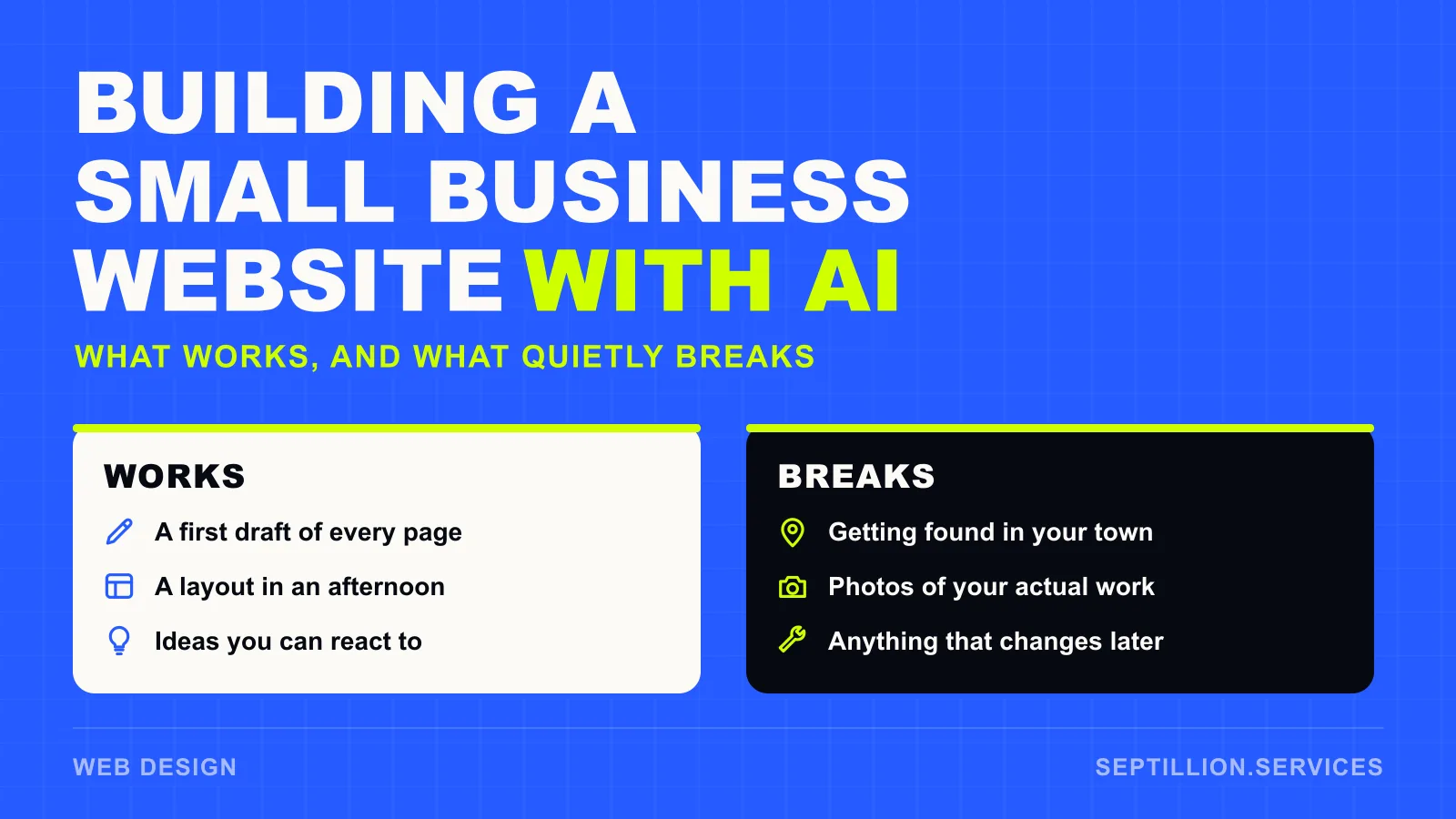
Quick answer: AI will build a small business website in an afternoon, and the result will look fine. Whether it works depends on five things the generator leaves blank — and all five are the reasons a website gets someone booked rather than merely seen.
What it gets right
The draft. Genuinely, completely right.
A layout that holds together, a page for each service, a first pass at the copy, and section ideas you wouldn't have listed yourself. For a business owner staring at a blank screen on a Sunday evening, that's worth more than it sounds. This part of the job is solved, and pretending otherwise helps nobody.
The five gaps
What the generator hands over is a website-shaped object. Here's what's missing from it.
- Local search — no town on the page means no map pack, and no nearby customers
- Real photographs — generated scenes are the one thing a local customer can spot
- A booking path — a contact form is not a booking, and neither is a phone number alone
- Google Business Profile — the listing most people see before they reach the website
- Everything after launch — prices, hours and services change; a generated site doesn't
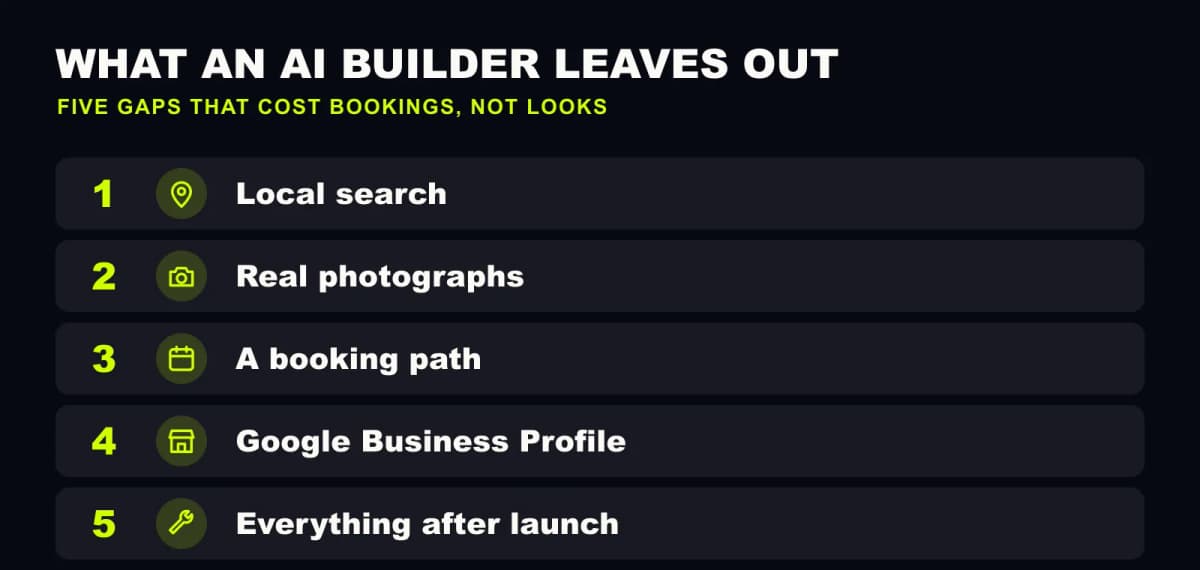
Notice what these have in common: none of them are design problems. The site looks fine with all five missing. That's why they get missed.
Why a generated site struggles in local search
Generated copy describes a trade, not a place. Ask for a plumbing website and you get paragraphs about reliable plumbing services — accurate, fluent, and identical to the text on every other plumbing site built from the same prompt.
What's missing is the only thing that matters locally: the name of the town, on the page, in a sentence a human would write. Without it there's nothing connecting your website to the place your customers are searching from, and the map results — which sit above everything else on a phone — have nothing to match you against.
The fix costs nothing. Name the towns. Match them to what's on your Google Business Profile. Keep the same business name, address and phone number everywhere they appear. That's most of local SEO for a small business, and none of it survives a generic prompt.
The photo problem
This one is worth more attention than it gets.
A generated photograph is the single element on a page a local customer can identify as fake, and once they've spotted it, everything else on the site gets read more sceptically — including the prices and the reviews. The trust you were buying with a polished image is exactly what it costs you.
Clean phone photos of real work beat generated scenes every time. Not because they look better — they usually don't — but because they're checkable. The same argument applies to a logo generated and shipped without anyone looking at it too closely, which is how small business branding quietly falls apart.
Three routes, and who's left holding it
There isn't a choice between "use AI" and "don't". Every route below starts from an AI draft. What differs is who deals with it afterwards.
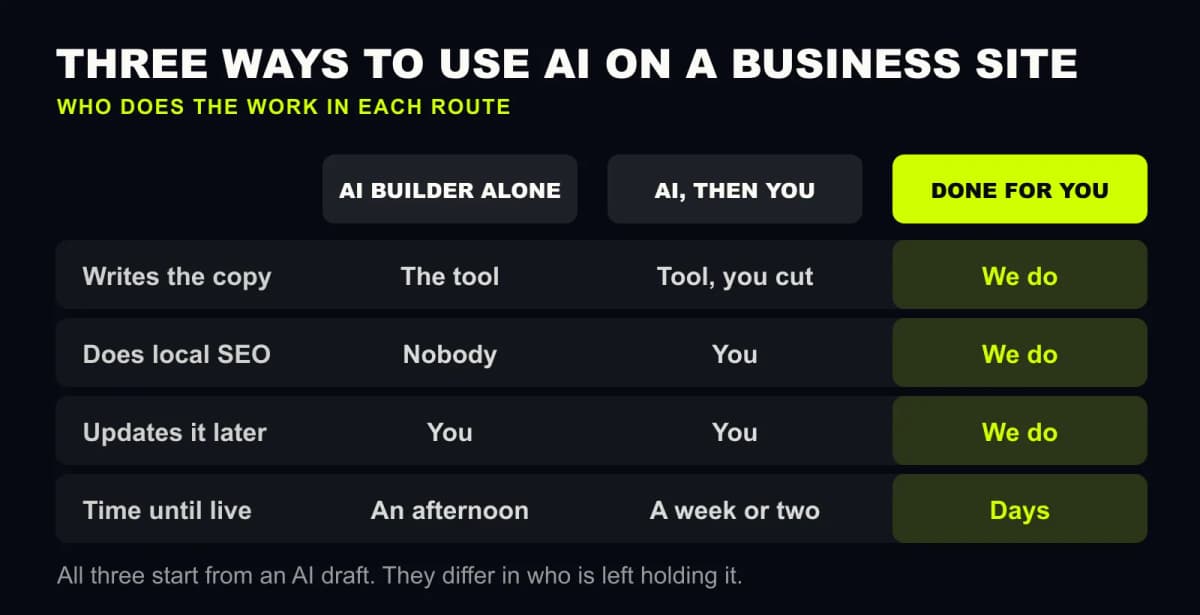
The middle column is the honest recommendation for most owners who have the time. The first works if the site is a business card. The third exists because "you update it later" is where the majority of small business sites quietly die — prices from two years ago, a service you stopped offering, hours that were right before you changed them.
How to use AI without ending up with a generic site
Four habits, and they take an evening between them:
- Generate the draft, then cut it by half — the step-by-step version of that process covers where to cut
- Put your town, your prices and the jobs you turn down in your own words
- Replace every generated image with a photo you took
- Give each page one action, and make it the same action the customer was already trying to take
That last one is where most sites lose the booking rather than the visit — the five places small UK businesses lose bookings is the longer version.
If you'd rather not hold it
We build the site, write the pages, name the towns, use your photographs, and keep all of it accurate every month — for one flat monthly rate, with nothing to pay until you've seen it. More on how we work with UK small businesses, or book a call and speak to the person who'd actually build it.